PS1
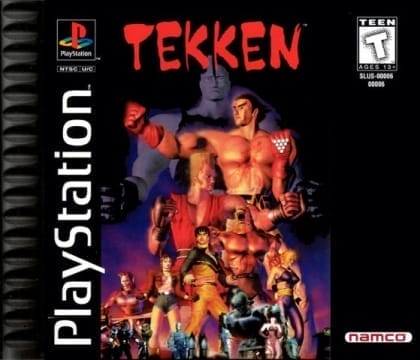
Tekken
The groundbreaking 3D fighting game that launched the legendary franchise. Features 10 playable characters including Kazuya Mishima, Paul Phoenix, and King, each with unique martial arts styles and devastating combos.
Share this game
Gameplay Systems
As with many fighting games, players choose a character from a lineup and engage in hand-to-hand combat with an opponent. Traditional fighting games are usually played with buttons which correspond to the strength of the attack, such as strong punch or weak kick. Tekken , however, dedicates a button to each of the four limbs of the fighter. The gameplay system includes blocks, throws, escapes, and ground fighting. In the original Tekken , players could only block attacks manually. From then on, starting with Tekken 2 , characters automatically block while not moving forward or performing actions, a feature called "neutral guard." Standing or retreating characters will block high and middle attacks with no input from the player, while crouching characters will duck high attacks and block low ones. Normal middle attacks will hit crouching players, but some special mid-attacks can be blocked by both stand and crouching neutral guards. Meanwhile, pressing backwards will give the player an "active guard" that can withstand certain combo attacks that would normally penetrate the neutral guard. Some characters are equipped with parries and reversals that act like traditional "press button to block" systems. Tekken 3 introduced several gameplay possibilities that were retained in later games, including the ability to sidestep into the foreground or background. Tekken 3 and later games also reduced recovery time after being knocked down and gave characters rolls to recover instantly after hitting the ground, allowing the player to get back into the fight more quickly at the risk of being hit while rolling. Tekken 4 was another leap, and gave characters even greater mobility by adding true 3D movement inside geometrically complex arenas with uneven ground, obstacles, and walls. The 3D gameplay allows damaging side and back throws as a reward for outmaneuvering the opponent, as well as evasive attacks that develop directly from a sidestep. Tekken 4 received mixed feedback to the point of being considered by some as one of the worst installments in the series which led to major changes starting with Tekken 5 . This was done thanks to the new engine provided by Namco. In retrospect, Harada believes Tekken 5 , and Tekken 6 , managed to attract a new group of fans, something Tekken 4 did not largely do. However, the game has significantly grown in acclaim after some years due to its realism in gameplay and gritty story arcs. Harada has even improved his thoughts on the game and has gone on to call it the best game or peak in the series during an interview for the new Tekken 8. According to Harada, the innovation went "the other way" or reverted to more conservatism beginning Tekken 5. Much of the positive changes and reviews were not focused on in Tekken 4, and instead Harada focused only on the negative reviews against it, which in hindsight was not the proper way to make a fighting game starting with Tekken 5. Thus, he felt the game could have been even better, despite the eventual huge success upon its debut in late 2004. Tekken 5 also saw a combination of walled and infinite arenas, while discarding uneven ground and terrain to allow more juggling. Tekken 6 retains much of the design from Tekken 5 , but it also includes a "Rage" mode, which activates when a character is near the end of his vitality bar and earns a damage multiplier. "Bound" (later known as "Ground Bound") hits were also added, in which a player connected with an airborne opponent will place him in an inescapable grounded state, allowing combo extensions. Tekken 6 also has destructible floors and walls that allow the fighters to blast through to new fighting areas when broken. Tekken Tag Tournament 2 retains these elements while also adding a new kind of stage break ("balcony breaks", which is a combination of floor and wall breaks where characters will go through a breakable wall and fall to a lower level in the same sequence). Tag 2 specific features include Tag Assaults (cooperative combos triggered by hitting a Bound and a tag at the same time) and Tag Crashes (an emergency tag occurring when downed and the partner is currently in Rage). Tekken 7 introduces some movement changes to the Tekken formula. The back walk animation is now similar to Tekken Revolution , featuring a more fluid movement away from the opponent as opposed to a slower shuffle. Regular back rolling from a grounded state has been removed and instead replaced with new rising animation and performing an "ankle kick" (kicking the standing opponent while laying face up on the ground) is now accompanied by a new back roll to help create separation. Balcony breaks from Tag Tournament 2 are present and function similarly to how they did in solo play. New features include "Power Crushes" (an attack that cannot be interrupted by regular attacks once the animation has begun) and "Rage Arts" (a super move attack that can only be used when your character has hit a Raged state near the end of their vitality meter, sacrificing the Rage mode to perform the attack). Bound has been mostly removed save for specific situations (certain moves can cause a Ground Bound if not combo-ed into and all low parries will cause a Ground Bound effect, similar to Tekken 6: Bloodline Rebellion ; floor breaks now result in an effect similar to a Tag Assault in Tag 2 rather than a standard Ground Bound) and instead, characters now have more frequent access to an "Aerial Tailspin" effect (an attack that throws an opponent backward onto their head as opposed to straight downwards, although it is still inescapable once triggered which means the combo can continue). Later Tekken 7 updates eventually add "Rage Drive" (also cost Rage mode, and is an equivalent of EX and lower level super moves) as of Tekken 7: Fated Retribution , with the console ports' post-Season 1 adds two new damage properties which were originally existed in previous characters and still can only work against an opponent while t
Sales & Commercial Performance
Total Copies Sold
55 million copies
Some information sourced from Wikipedia, available under CC BY-SA 3.0.