NES
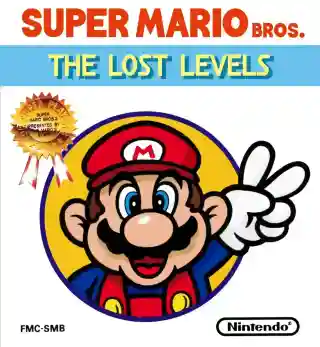
Super Mario Bros.: The Lost Levels
Super Mario Bros.: The Lost Levels is the international release of the original Japanese Super Mario Bros. 2 for the SNES via Super Mario All-Stars. Features extremely challenging platforming with wind mechanics, poison mushrooms, and backwards warp zones designed to test the most skilled Mario players.
Share this game
Gameplay Systems
The Lost Levels is a 2D side-scrolling platform game similar in style and gameplay to the original 1985 Super Mario Bros. , save for an increase in difficulty. As in the original, Mario (or Luigi ) ventures to rescue the Princess from Bowser . The player jumps between platforms, avoids enemies and obstacles, finds secrets (such as warp zones and vertical vines) and collects power-ups such as the mushroom (which makes Mario grow), the Fire Flower (which lets Mario throw fireballs), and the Invincibility Star . Unlike the original, there is no two-player mode, but at the title screen the player chooses between Mario or Luigi. Their abilities are differentiated for the first time: Luigi, designed for skilled players, has slower acceleration and deceleration with a higher jump height, while Mario is the opposite; he has faster acceleration and deceleration, but has a lower jump height. The Lost Levels continues the difficulty progression from Super Mario Bros . It introduces obstacles including poison mushrooms, warps that return the player to previous levels , and gusts that redirect the player midair. The poison mushroom, in particular, works as an anti-mushroom, shrinking or killing the player character. Some levels require "split-second" precision and others require the player to jump on invisible blocks. After each boss fight, Toad tells Mario that "[their] princess is in another castle" . The main game has 32 levels across eight worlds and five bonus worlds. A hidden World 9 is accessible if the player does not use a warp zone. Bonus worlds A through D are accessible when the player plays through the game eight times, for a total of 52 levels.
Media Reviews
IGN
1980
Eurogamer
2
EGM
1986
Some information sourced from Wikipedia, available under CC BY-SA 3.0.