
SNES
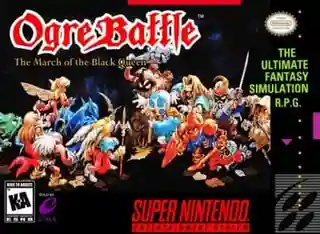
Ogre Battle: The March of the Black Queen
Ogre Battle: The March of the Black Queen is a tactical role-playing game developed by Quest and published by Enix for the SNES. Set in a fantasy world, the game combines real-time strategy with RPG elements as players lead a rebellion against an evil empire. The game is renowned for its complex gameplay mechanics and multiple endings.
Release Date
January 1, 1993
Developer
Quest CorporationPublisher
Quest Corporation
Players
1
Region
US
ROM Size
1.2 MB
Share this game
Story
Twenty-five years prior to the beginning of the game, five separate kingdoms ruled the continent of Zetegenia. A war broke out, and Endora, the ruler of the Northern Highlands, conquered the other four kingdoms with the aid of the Sage Rashidi and his dark magic in but a year. Rashidi also betrayed his former friend King Gran of Zenobia (one of the other four kingdoms) and arranged his death. Endora became Empress of the new Zetegenian Empire, but under Rashidi's influence her rule became harsh and cruel. During her reign, a resistance organization called the Liberation Army forms from the remnants of the Knights of Zenobia, and seeks to free the continent from her rule. At the beginning of the game, the protagonist, whose name, gender, and other characteristics are chosen by the player, takes command of the Liberation Army. Throughout the course of the game, the protagonist is joined by various other characters, such as Lans, a knight who served the king of Zenobia until the king's death; Warren, a wizard with the ability to divine the future; Tristan, the rightful prince of Zenobia; and many others. As the game proceeds, the Liberation Army eventually frees much of the continent and eventually invades the Highlands. Empress Endora, her son Prince Gares, and Rashidi are slain. Before Rashidi dies, he uses his blood to release Diablo, the king of the Underworld who was sealed away after the first great Ogre Battle. The protagonist and their army manage to seal Diablo away again before he can become too powerful. There are multiple outcomes to the story depending on various factors such as the protagonist's alignment, their reputation, which characters they choose to recruit, and completing certain sidequests. In "bad" endings, the country they build is as evil as Endora's empire or even worse; "good" endings tend to involve either the protagonist becoming a just ruler, or putting Prince Tristan on the throne.
Gameplay Systems
Top: Moving across the stage map. Bottom: A battle scene taking place. (SNES version) Ogre Battle: The March of the Black Queen begins in the outskirts of the Zeteginean Empire, 24 years after the founding of the empire through conquest. The main character is leading a revolution against this empire, which has turned to evil through the use of black magic by the mage Rashidi. The main character's name and gender is chosen by the player, and called the "Opinion Leader" in the instruction manual. The game begins with the seer Warren using tarot cards to ask a series of questions to determine the player's suitability as leader of the revolution. There are several questions out of a fixed set which are randomly asked, each of which is associated with one of the 22 Major Arcana cards of divinatory tarot . The player's answers to these questions determine the Opinion Leader's abilities and starting units. Ogre Battle mixes movement elements of a real-time tactics game with the character development and combat of a role-playing game . The game consists of a series of battles in which the player deploys units to fight against enemies and liberate occupied towns and temples. On the world map, the player can manage their characters, change their class, equip equipment, and choose the next stage to proceed to. Picking an already completed stage will not respawn the main enemies, although neutral monsters may still be there. The player is free to organize multiple squads of five fighters or fewer, with some large characters such as dragons or griffons counting as two for the purpose of squad size. Time passes on the tactical map, alternating between day and night. Time of day has several effects; for example, vampires and werewolves only function during the evening, with the former appearing in coffins during the day, and the latter appearing as normal men. Deploying a squad costs a small amount of money, which must be paid again as maintenance every time a day passes. Towns and temples on the map can be liberated by units, and retaken by Zeteginea if left undefended. Upon liberation, a random tarot card is drawn, which can have a variety of effects. Liberated towns also provide income when a day passes. Some towns have shops where money can be spent on consumable items and equipment. Also, some towns and temples are hidden and do not display on the initial map; only moving a unit over the area will reveal it, as well as hidden caches of treasure. Each stage has a boss; defeating the boss completes the mission. Both during and after the stage, towns and temples can be visited to gain information or items. There are 25 main stages in the game, with some variation possible in how the stages are played. There are also four hidden stages accessible through the main game with an additional stage as an easter egg . The game can be completed without finishing all the stages. There are 13 different endings to the main game, depending on the conduct of the player during the course of the game. Battle Each stage has a number of enemy units that attempt to re-capture the player's towns and temples. If two units move close to each other, a battle ensues. During a battle, the view shifts to a close-up view of the two combatant units. Characters alternate taking actions with the battle ending after one round of combat (many units can attack multiple times per round). The unit that caused the most damage is the victor and forces the other unit to retreat. During a battle, a player does not directly control their unit, but selects a tactic for the unit to follow (Best, Strong, Weak, Leader), which the characters follow when choosing whom to attack. The player can also use stored tarot cards, which can cause damage or have a special effect. The Lovers card will cause all affected enemies to fight for the player; the Moon card will change the formation of the enemy unit, causing them to attack differently; the Fool card will remove all enemies but the leader from battle. The player also has the option of retreating from any encounter.
Media Reviews
IGN
6/10
GameSpot
7.8/10
Famitsu
32/40
Eurogamer
9/10
Game Informer
6.5/10
Electronic Gaming Monthly
30/40
Nintendo Power
3.2/5
Some information sourced from Wikipedia, available under CC BY-SA 3.0.