PS1
Civilization II
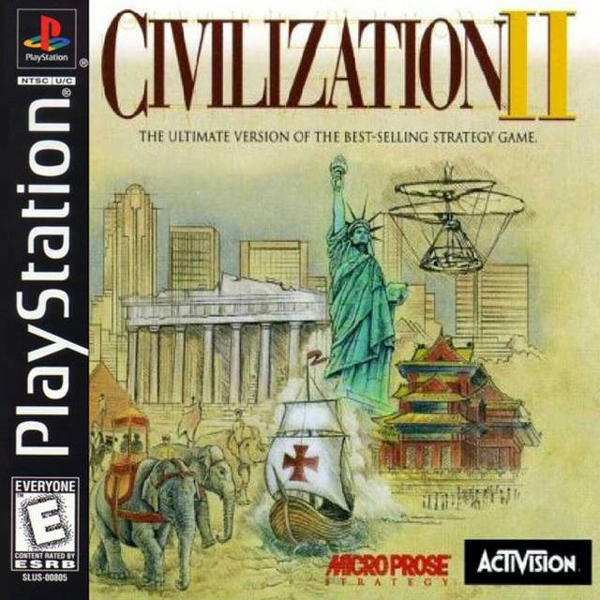
Sid Meier's Civilization II is a turn-based strategy video game in the Civilization series, developed and published by MicroProse. It was released in 1996 for PCs, and later ported to the PlayStation by Activision. Players build a civilization from a primitive tribe, competing with rival computer- or human (in some editions)-controlled civilizations. They manage cities and units in a quest to assure their civilization's dominance—either by conquering all other civilizations or by manufacturing advanced space technology.
Share this game
Gameplay Systems
As a turn-based strategy game, Civilization II models the historical development of human civilization. A player, when creating a game, may pick one of 21 historical civilizations or a custom-named civilization. The computer will intelligently control multiple rival civilizations. Only a single-player mode was available until the release of the Multiplayer Addon. The following civilizations appear in the game: Americans , Aztecs , Babylonians , Carthaginians , Celts , Chinese , Egyptians , English , French , Germans , Greeks , Indians , Japanese , Mongols , Persians , Romans , Russians , Sioux , Spaniards , Vikings and Zulus . Barbarians are non-playable NPC characters. The game takes place on a map made of tiles. A human player may generate a random map based on their specifications, or opt for a pre-made map. Different terrain types, special resources and improvements such as irrigation are present on different tiles. Players begin with one or a few units, including settlers to found their first cities, in 4000 BC. All of the map is unexplored except the starting units' immediate vicinity, and exploration is a top early-game priority. Cities occupy one tile and harvest yields from nearby tiles: food, trade and production. They may build units, city improvements or wonders of the world . Typically, each civilization will constantly expand by founding new cities until all of the map is settled. Analogous to chess pieces , the many different units vary in their functions, mirroring historical types of soldiers and occupations. Units occupy one tile at a time and may move every turn. Most of them can attack others in battle; a minority have non-military functions. After civilizations make contact, they begin diplomatic relations. In war, a civilization may conquer another civilization's cities. When all of a player's cities are conquered, they are permanently removed from the game. To end war, two players may promise peaceful relations. Scientific research is a focal point of the game. Players begin with primitive technology and hence limited possible actions. Grouped by eras from ancient to modern, civilization advances, both scientific and societal, offer numerous advantages. There are three paths to victory: conquering all other civilizations, building a spaceship that reaches the Alpha Centauri star system using advanced technology, and otherwise surviving until 2020 AD. A player's score is calculated after finishing the game. Other features Civilization II supports mods that customize game graphics or mechanics. "Scenarios" are preset game files that emulate historical, fictional or other situations.
Sales & Commercial Performance
Total Copies Sold
1.2 million copies
Total Revenue
$21.1 million
Some information sourced from Wikipedia, available under CC BY-SA 3.0.