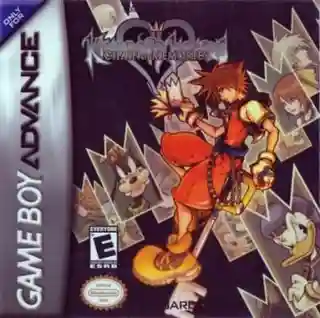

GBA
Kingdom Hearts: Chain of Memories
This GBA installment bridges Kingdom Hearts I and II with an innovative card-based battle system. Sora, Donald, and Goofy explore Castle Oblivion where memories shape reality, encountering both familiar Disney worlds and Organization XIII members.
Share this game
Story
Kingdom Hearts chronology Kingdom Hearts χ Dark Road Birth by Sleep A Fragmentary Passage Kingdom Hearts Chain of Memories 358/2 Days Kingdom Hearts II Coded Dream Drop Distance Kingdom Hearts III Melody of Memory Kingdom Hearts IV v t e Setting Kingdom Hearts: Chain of Memories takes place immediately after the events of Kingdom Hearts , the first game in the eponymous series. It takes place in Castle Oblivion, a mysterious castle Lord Marluxia keeps. Sora and his teammates are told that the castle causes visitors to lose their memories upon entering. The lobby and areas between floors have a flower theme, and each floor is changed into a different world from the first Kingdom Hearts game using "world cards", which are created from Sora's memories. The worlds in Chain of Memories are created from Sora's memories, and many of the events of Kingdom Hearts are relived in this game. Sora encounters memory-based versions of Disney characters he meets in Kingdom Hearts . The plot lines differ from those of the first game and involve memory. Chain of Memories introduces Twilight Town, a world that is created from memories on " the other side of [Sora's] heart ", in addition to the original worlds of Kingdom Hearts .
Gameplay Systems
Kingdom Hearts: Chain of Memories is a combination of a role-playing video game and a collectible card game . There is an experience point system that can be used to increase the character's maximum health and Card Points or to learn new skills. The cards are used in the progression of the story and in combat. The game features a world map and a battle screen. The world map is an isometric area where the player traverses rooms. Enemies inhabit the world and track the player to engage in combat, which is initiated when the player and an enemy come into contact. Once in combat, the game switches to the battle screen, which uses the card-based battle system. To advance through the game, the player uses map cards they obtain after winning battles to create rooms through "room synthesis". The map card the player chooses determines the properties of each room―including the quality of items and the strength of enemies. The color of each card has a specific effect: red cards affect the number and type of enemies; green cards affect the power of the player's deck; and blue cards affect the properties of the room, such as the allowance of treasure chests or the appearance of save points . The game has three modes; two are story modes featuring Sora and Riku , and the third is a two-player battle mode. Initially, only Sora's story mode is available; once that story is completed, the "Reverse/Rebirth" mode becomes available. Reverse/Rebirth allows the player to play the second story mode featuring Riku and the battle mode in which two players using a Game Link Cable can battle each other. Combat Chain of Memories uses a real-time card-based battle system. The player can jump and maneuver around the battle screen as they do on the world map, but playing cards activate all attacks and other actions. Cards are ranked from zero to nine, and they can be used to make attack combinations (combos) or to break enemy cards. Card points (CP) are required to place cards in the player's deck; except for zero-ranked cards, high-ranking cards cost more CP than low-ranking cards. The player's CP, which is increased by leveling up , limits the number of cards the player can use in a deck. Breaking an opponent's card will cancel that attack and briefly stun the character. Zero-ranked cards can break any opposing card or combo if they are played after the opposing card or combo, but can be broken by any card or combo. Special enemy cards can be obtained by defeating enemies and bosses; these give the player temporary abilities such as enhanced offensive and defensive capabilities or the ability to modify the attributes of certain cards. Combo attacks are created by combining cards in sets of three. Because the combo's rank is the sum of its three constituent cards, these are usually more difficult to break. Some card combinations create a "sleight", a special combination that creates either a powerful physical attack, a magical spell, or a summon attack. After a card combo is played, the first card in the combo becomes unusable until the end of combat. The deck must be reloaded when the player runs out of cards. Sora's and Riku's stories have some differences in gameplay. In Sora's story, Sora obtains cards by defeating enemies or by purchasing them at Moogle shops. In some cases, Sora must unlock specific cards through plot events before they become available. Sora can create and store three decks in the pause menu. Riku has a closed deck that cannot be customized, and the cards in his deck change depending on the world he occupies. Riku is limited to mainly physical attacks, enemy cards, and Mickey Mouse ally cards. Riku can activate "dark mode" and unlock his sleight attacks if he accumulates enough "dark points", which are earned by breaking enemy cards and combos. The difference between Riku's card or combo and the enemy's card or combo is the number of dark points Riku will accumulate for that card break.
Sales & Commercial Performance
Total Copies Sold
1.50 million copies
Total Revenue
$28 million
Media Reviews
IGN
8/10
GameSpot
6.5/10
Famitsu
36/40
Eurogamer
8/10
Game Informer
7.75/10
Some information sourced from Wikipedia, available under CC BY-SA 3.0.