
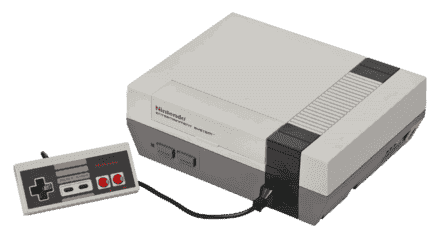
NES
Donkey Kong
The 1983 NES port of Nintendo's seminal 1981 arcade game that introduced Mario (as Jumpman) and Donkey Kong. Players ascend construction sites to rescue Pauline from the giant ape across four iconic stages: 25m, 50m, 75m, and 100m.
Share this game
Story
This followed the 1973 oil crisis , which increased the cost of manufacturing toys, and the success of Taito 's arcade game Space Invaders (1978). In 1980, Nintendo released Radar Scope , a Space Invaders -style shoot 'em up . It was a commercial failure and put the newly established subsidiary Nintendo of America in a financial crisis. Its founder, Minoru Arakawa , asked his father in-law, Nintendo CEO Hiroshi Yamauchi , to provide a new game that could repurpose the unsold Radar Scope cabinets. Most of Nintendo's top developers were preoccupied, so the task went to Shigeru Miyamoto , a first-time game designer. Supervised by Gunpei Yokoi , Miyamoto settled on a love triangle with the characters Bluto , Popeye , and Olive Oyl from the Popeye franchise, but a licensing deal between Nintendo and King Features fell through. {{cite web |last1=Handley |first1=Zoey |title=Popeye might be the most insulting adaptation of a classic arcade game |url=https://www.destructoid.com/weekly-kusoge-popeye-2021-switch-ps4/ |website=[[Destructoid]] |access-date=November 15, 2024 |date=May 9, 2022}}</ref>"}},"i":0}}]}'> Bluto evolved into a gorilla, an animal Miyamoto said was "nothing too evil or repulsive". He was named Donkey Kong — donkey to convey stubborn and kong to imply gorilla . Popeye became Mario , the new protagonist, while Olive Oyl became Pauline , the damsel in distress . Miyamoto cited the fairy tale " Beauty and the Beast " and the 1933 film King Kong as influences. Donkey Kong was one of the earliest platform games , {{cite web |last1=Gaming |first1=Nodwin |title=The evolution of platform games in 9 steps |url=https://www.redbull.com/in-en/evolution-of-platformers |website=[[Red Bull]] |access-date=February 23, 2023 |date=March 23, 2017 |archive-date=February 23, 2023 |archive-url=https://web.archive.org/web/20230223204455/https://www.redbull.com/in-en/evolution-of-platformers |url-status=live}}</ref>"}},"i":0}}]}'> with players controlling Mario as he ascends a construction site to rescue Pauline from Donkey Kong. Whereas previous platform games focused on climbing, Miyamoto placed an emphasis on jumping to avoid obstacles and cross gaps. He envisioned something akin to a playable comic strip that unfolded across multiple levels with unique scenarios. This was uncommon in contemporary arcade games, which typically featured a single scenario that repeated. As he lacked programming expertise, Miyamoto consulted technicians on whether his ideas were possible. Four programmers from Ikegami Tsushinki spent three months turning Miyamoto's design into a finished game. Although Miyamoto's team was told it would be a failure, Donkey Kong became Nintendo's first major international success upon its release in July 1981. The $280 million windfall gain rescued Nintendo of America from its financial crisis and established it as a prominent brand in the United States. Donkey Kong achieved further success in 1982, when Nintendo released a Game & Watch adaptation and licensed it to Coleco for ports to home consoles . It grossed $4.4 billion across various platforms, making it one of the highest-grossing games of all time. In 1982, Universal City Studios filed a lawsuit alleging Donkey Kong violated its trademark of King Kong . The lawsuit failed when Nintendo's lawyer, Howard Lincoln , discovered that Universal had won a lawsuit in 1976 by declaring that King Kong was in the public domain .
Gameplay Systems
Original series Donkey Kong and Donkey Kong Jr. are early examples of the platform game genre. In both games, the player must guide the playable character (Mario in the first game, Donkey Kong Jr. in the second) to scale four levels while avoiding obstacles. The player jumps to dodge incoming obstacles (such as barrels) or cross gaps and climbs ladders or vines to reach the top of the level. In the first game, Mario can destroy obstacles by obtaining a hammer power-up , while in the second, Donkey Kong Jr. can do so by knocking pieces of fruit down from vines. Points are awarded for dodging or destroying obstacles, collecting items, and completing stages quickly. The player begins each game with three lives , which they lose if they touch an obstacle or fall. Donkey Kong 3 departs from this gameplay: it is a shooter game in which the player controls Stanley, an exterminator who must prevent Donkey Kong from stirring up insects in his greenhouse. The player fires bug spray at Donkey Kong and enemy insects that attempt to steal Stanley's flowers. They complete levels by spraying Donkey Kong enough to force him to the top of the screen or by killing all the insects. The 1994 Game Boy game begins with the four stages from the original Donkey Kong , but after completing the fourth, the player is presented with over 100 additional stages that introduce puzzle-platform gameplay in which Mario must scout each level within a time limit to locate a key. Mario can pick up and throw objects and enemies, similar to Super Mario Bros. 2 , and perform acrobatics to reach otherwise inaccessible areas of the levels. This gameplay would serve as the basis for Mario vs. Donkey Kong , which introduces stages in which Mario must guide six Mini-Mario toys to a toy box while protecting them from hazards. Mario vs. Donkey Kong ' s sequels make guiding the Mini-Mario toys the focus, with each stage requiring the player to do so with touchscreen controls. This gameplay has been frequently compared to the strategy video game Lemmings (1991).
Sales & Commercial Performance
Total Copies Sold
65 million copies
Some information sourced from Wikipedia, available under CC BY-SA 3.0.