N64
Banjo-Kazooie
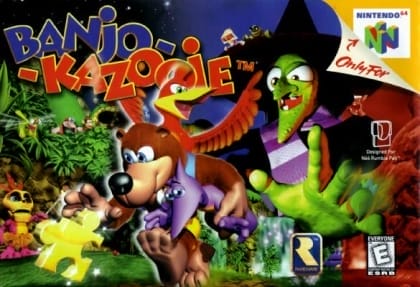
Banjo-Kazooie is a platform game developed by Rare and published by Nintendo for the Nintendo 64. The game follows bear Banjo and bird Kazooie as they attempt to stop the witch Gruntilda from stealing Banjo's sister Tooty's beauty. Players explore nonlinear worlds to collect musical notes and jigsaw puzzle pieces.
Share this game
Story
An ending sequence in Banjo-Kazooie , should the player collect all 100 Jiggies in the game, indicated that two coloured eggs in the game would be put to use in the sequel Banjo-Tooie . There was also an inaccessible ice key shown in the sequence, which induced gamers to search for a way to get it. While only two eggs were shown in the sequence, hackers Alan "Ice Mario" Pierce and Mitchell "SubDrag" Kleiman of the Rare Witch Project fansite discovered in-game cheat codes to unlock a total of six different eggs and the ice key. Other ways of getting the six eggs and key were previously discovered via the use of a cheat cartridge . Once acquired, these items would be viewable by all three game files, and would remain even after erasing the files. In the years between the two Banjo-Kazooie games, Rare representatives were questioned on "Stop 'N' Swop" and how it would be implemented. Ken Lobb was reportedly unwilling to discuss how the connection would be made between the games. Banjo-Tooie was released in 2000 and offered a way to retrieve the items without the need to acquire Banjo-Kazooie . The player would attain them by destroying in-game Banjo-Kazooie Game Paks. These eggs could then be brought to Heggy the hen to hatch. There were three eggs in total (i.e. the pink, yellow, and blue eggs), one of which was already with the hen, but which Kazooie had to hatch herself. The ice key, however, was to be used to obtain an item locked in an ice vault, containing a Mega Glowbo, which could turn Kazooie into a dragon . No explanation for "Stop 'N' Swop" was revealed in the game. Nintendo released a statement on the matter expressing that the feature "was not implemented in the game, and although we know there is a code that opens this menu, it does not do anything at all. And as much as I would like to be able to answer your question about why it was not implemented in the game, this is not information that our Consumer Service Department has access to." In 2004, a patent filed by Rare was published which suggests that Stop 'N' Swop involved swapping cartridges with the power off to transfer data. The information would be momentarily retained by utilising the Rambus memory in the Nintendo 64. As a result of changes done to the Nintendo 64 systems produced in 1999, the system could no longer do this effectively. In February 2004, fansite Rare-Extreme was invited to tour Rare HQ which was the first outsider tour of the studio since Rarenet's visit in 1999. When Rare's management was asked about the Stop 'N' Swop feature in a 2004 HG Tour, they pointed out that "It was never officially announced as being part of the game," and immediately requested that the tour "move on." Another Stop 'N' Swop reference appeared in 2005's Banjo-Pilot . After completing most of the game, Cheato sells an item called "STOP 'N' SWOP" for 999 Cheato Pages. The only result of buying is Cheato saying: " So you want to know about Stop 'N' Swop, eh? I hope you're ready. Here goes...Why don't you stop annoying me and swop this game for a nice book or something? " In 2008, MTV conducted an interview with Salvatore Fileccia, lead software engineer at Rare. Fileccia cited that the abandonment of Stop 'N' Swop was due to revisions made to the Nintendo 64 circuitry. He stated that older versions of the system would have given the player 10 seconds to successfully swap data between cartridges, while newer iterations of the console reduced this time to one second. Paul Machacek, a Rare software engineer, clarified that Nintendo shut down Stop 'N' Swop before Donkey Kong 64 's release, anticipating the aforementioned circuitry changes as well as fearing hardware damage (a fear which Machacek claimed was unfounded ), although the "Swopping" system was never fully removed from Kazooie . Rare did not initially plan to implement cheat codes for accessing the items, fearing that they could be shared with players that did not own Tooie . In a 2007 interview with Retro Gamer , Rare employees told the magazine reporters that they may have to wait until the release of Banjo-Kazooie: Nuts & Bolts for the details of Stop 'N' Swop to be revealed. At Microsoft's E3 press conference on 14 July 2008, it was announced that the original Banjo-Kazooie would be made available through the Xbox Live Arcade (XBLA) and feature Stop 'N' Swop connectivity with Nuts & Bolts to unlock new features. Collecting Stop 'N' Swop items in Banjo-Kazooie causes special item crates to appear in Nuts & Bolts , which can be redeemed for special vehicle parts. It was revealed that the eggs and key in the XBLA version of Banjo-Kazooie would unlock bonus vehicle parts in Nuts & Bolts such as fuzzy dice . On 27 January 2009, Rare announced that Banjo-Tooie would be released in April on XBLA and that the "original plan" for Stop 'N' Swop would be implemented. In the XBLA port of Banjo-Tooie , the six eggs and key from Banjo-Kazooie unlock the bonuses included in the original N64 version, as well as new content related to the Xbox 360. Using the Stop 'N' Swop items in Banjo-Tooie will also unlock seven additional vehicle blueprints in the "L.O.G.'s Lost Challenges" downloadable content for Nuts & Bolts . In place of the three preexisting eggs are gold, silver and bronze eggs. The three unlock achievements listed under a "Stop 'N' Swop II" submenu. Additional Stop 'N' Swop II achievements can be unlocked by completing specific objectives in the game. These achievements, however, currently serve no in-game or cross-game functionality. In 2018, Paul Machacek clarified that Stop 'N' Swop was not only going to involve the two Banjo-Kazooie titles, but also other Rare titles planned for release on the Nintendo 64, including Donkey Kong 64 , Conker's Bad Fur Day and Blast Corps (the latter was initially planned to release after Banjo-Kazooie as it was slated for Christmas 1997 before being delayed). In a 2020 interview conducted by Rare Gamer, Machacek stated
Some information sourced from Wikipedia, available under CC BY-SA 3.0.